Self-drive car rental FAQs answered for India in 2026: which number plate is legal, what insurance excess you actually pay, deposit rules, and Himachal permits.
Key takeaways
- A legally rentable self-drive car in India carries a black number plate with yellow lettering. A white plate means a private car being rented illegally, and the fine lands on you at the checkpost.
- "Comprehensive insurance included" almost never means zero liability. Expect an excess of roughly ₹5,000 to ₹15,000 depending on car class, plus exclusions for tyres, glass, and underbody.
- Anyone who drives the car must be named on the rental agreement and verified. An unlisted driver at the wheel is the fastest way to void a claim.
- Traffic e-challans reach the registered owner, which is the rental company, sometimes weeks after your trip. Ask how they handle it before you hand back the keys.
- Himachal changed several rules in 2026, including a new state entry toll and a migrated Rohtang permit portal. Old blog posts and old bookmarks will send you to the wrong place.
In this guide5 sections
Most self-drive car rental FAQs stop at documents and deposits. This one starts where those end. Below are the questions people ask us on WhatsApp after they have already read three rental guides and still do not know whether the car outside their gate is legal to rent, what "insurance included" actually costs them when a bumper cracks, or which Himachal permit they need this season.
If you want the ground-level basics first, the complete guide to renting a self-drive car in India covers licence age, ID, and the booking process. Start there, then come back here for the fine print.
Is renting a self-drive car in India legal?
Yes, and the rules are older than most people assume.
Self-drive rentals operate under the Rent a Cab Scheme, 1989, made by the central government under sub-section (1) of section 75 of the Motor Vehicles Act, 1988, to regulate the business of renting motor cabs to people who want to drive them themselves. The scheme applies to motor cabs holding tourist permits issued under sub-section (9) of Section 88 of the Act, and now also covers battery-operated cabs and those running on methanol or ethanol.
What that means in practice is that the operator needs a state-issued licence, and the car needs commercial registration rather than private registration. An operator who has neither is not offering you a cheaper deal. They are offering you their risk.
Why does the number plate colour matter so much?
Because it is the one thing you can verify in two seconds, standing in your own driveway, before any money changes hands.
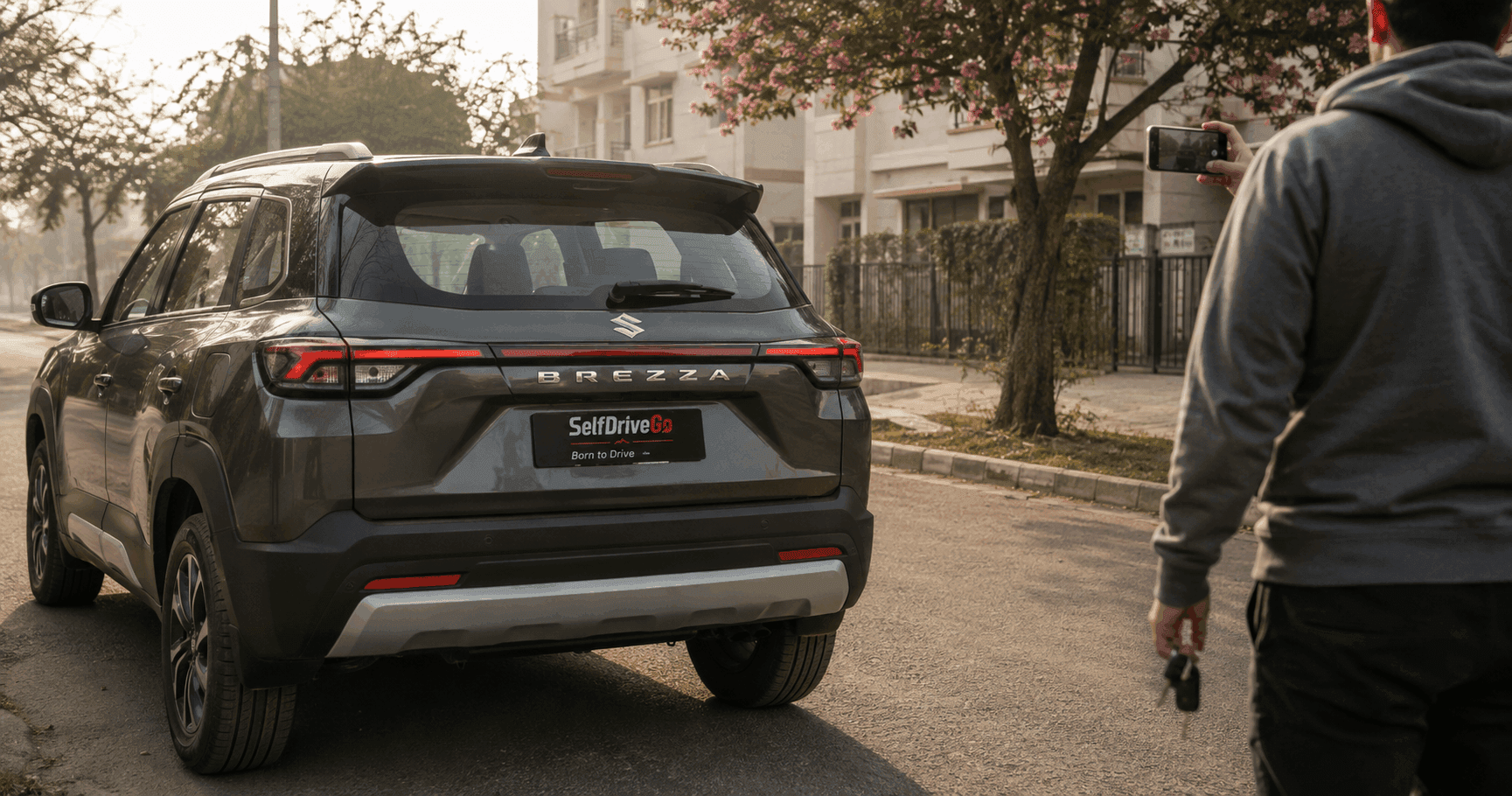
Vehicles operating under the Rent-a-Cab Scheme display the registration mark in yellow letters on a black background, which separates them from other commercial transport vehicles that use black on white. A white plate with black lettering is a private car. Renting one out is a commercial use of a non-commercial vehicle.
The consequences are not theoretical. Through 2025, state transport departments ran coordinated drives against unlicensed white-plate rentals, and Delhi's Transport Department issued public notices warning of vehicle seizure and fines above ₹10,000. Karnataka introduced a digital permit verification portal linked to the Vahan database, and Goa froze new Rent-a-Cab licences in 2024 before revising its policy.
We rent cars for a living, so treat this as advice against our own interest when it applies to us too. Ask any operator, including us, to show you the plate and the permit before you pay a deposit. An operator who gets defensive about that question has told you everything.
Do I need a commercial licence to drive one?
No. A standard private driving licence is enough for a black-plate self-drive rental. The vehicle is registered commercially, but the person hiring it drives on their ordinary licence, which is what separates this category from a yellow-plate taxi.
Money questions
What is a security deposit really for, and when should it come back?
It is refundable collateral against damage rather than a fee. Across the Indian market it sits roughly between ₹3,000 and ₹10,000 for a standard car and higher for premium SUVs. Ours is ₹5,000 for cars and ₹2,000 for bikes.
The number matters less than the return timeline, and you should get that in writing at pickup. A deposit that comes back the same week is normal. A deposit that needs three follow-up calls is a signal about how the rest of the relationship will go.
Is fuel included?
Almost never, anywhere in India. You get the car at a fuel level and return it at the same level.
The dispute this creates is always about what "same level" meant. Photograph the fuel gauge and the odometer at handover, in the same frame as the dashboard clock if your car shows one. Two seconds of work, and it ends the argument before it starts.
How do kilometre limits work?
Every rental carries a daily cap, commonly 200 to 300 km, and charges an overage rate past it. Across our fleet the cap runs 300 km/day on hatchbacks and 4x4s and up to 400 km/day on the Fortuner, with extra kilometres at ₹8/km.
Do the arithmetic before booking rather than after. Chandigarh to Manali is about 310 km each way. A three-day rental at 300 km/day gives you 900 km included, and a return trip plus Solang and a Rohtang day puts you close to 800. That works. The same three-day booking for Spiti, which is 410 km out before you have driven a single valley road, does not. Either extend the rental to buy included kilometres or ask for an unlimited package. Our breakdown of where self-drive rental costs actually come from runs the numbers on this properly.
What about tolls and traffic challans?
Tolls are yours, and FASTag makes them invisible until the statement arrives.
Challans are the one that catches people. An e-challan is issued against the registration number, so it goes to the registered owner, which is the rental company, not to you. It can land days or weeks after you have returned the car and collected your deposit. Ask any operator how they handle post-rental challans, and whether they hold part of the deposit back for it. Different companies answer this very differently.
Insurance, damage, and the excess nobody mentions
If insurance is included, why would I pay anything?
This is the single biggest gap between what renters expect and what happens.
Every rental car in India must carry third-party insurance under the Motor Vehicles Act. Most reputable operators add comprehensive own-damage cover on top. Neither means your liability is zero. The deductible, also called the excess, typically runs ₹5,000 to ₹15,000 depending on car class. You pay the deductible and insurance covers the rest, so a ₹50,000 panel repair on an SUV with a ₹15,000 excess costs you ₹15,000.
That is the deal working correctly. It is still ₹15,000 out of a pocket that read the word "included" and assumed otherwise.
What is usually not covered?
Policies vary, so read yours. The exclusions that show up most often across Indian self-drive rentals are tyres and rims, glass and windscreen chips, mirrors and lights, the underbody, the interior, and clutch or gearbox damage from misuse. Off-road use outside an agreed route, drunk driving, and wilful negligence are excluded almost universally.
On a Himalayan route this list is not academic. Underbody scrapes and windscreen chips from gravel are exactly what happens on the road to Kaza, and they are exactly what sits outside a standard policy.
Can my friend drive if they have a licence?
Only if they are named on the rental agreement and their licence has been verified by the operator first. Most companies, including us, add extra drivers at no charge.
Skipping this to save an hour of paperwork is the most common way people quietly void their own cover. If an unlisted driver is at the wheel during an incident, the insurer has a clean reason to decline, and the repair bill stops being an excess and starts being the whole amount.
What do I do if the car is damaged?
Stop. Do not move the vehicle until you have photographed it. Call the operator before you call anyone else, because their insurer will want the incident reported immediately and a delay can affect the claim.
Photograph the damage, the other vehicle if there is one, the road, the position of both cars, and the plates. For injuries, 100 for police and 102 for ambulance. Everything after that is paperwork the operator should be walking you through.
Permits and interstate driving in 2026
Himachal changed enough this year that a guide written in 2024 will actively mislead you.
Do I need a permit to drive from Punjab into Himachal?
The interstate tourist permit is the operator's job, and it should already be included in your quoted price. Ask, in writing, before booking. It is the cleanest single question for exposing a company that quotes low and bills later.
Separately, Himachal introduced a vehicle entry toll under its Toll Policy 2026-27, reported at ₹100 per day for private cars registered outside the state and effective from 1 April 2026, collected once at the first entry barrier and valid statewide for 24 hours. Confirm the current slab before you travel, since state toll notifications get revised mid-season.
What is the Rohtang permit situation this year?
There are three different permits and picking the wrong one is a common, expensive mistake.
The tourism permit covers visiting Rohtang Pass itself, with a daily quota of 1,200 vehicles split as 800 petrol and 400 diesel, a vehicle-age limit of under 10 years, a cap of three permits per vehicle per week, and no permits at all on Tuesdays when the pass closes for maintenance. For cars and jeeps the sightseeing permit costs ₹550 in total, made up of a ₹500 permit fee plus a ₹50 congestion charge, with slots released in two windows at 10:00 and 16:00, and a printout is compulsory at the barrier.
Two things that save people real money and time. A permit for travel beyond Rohtang towards Leh or Spiti costs only ₹50, and the Atal Tunnel needs no Rohtang permit at all, which makes it the permit-free route to Lahaul, Spiti, and Leh. The administration also moved off the old .nic.in domain to the official Rohtang permit portal on .hp.gov.in in early 2026, so an old bookmark will land you on a stale page.
Do I need an Inner Line Permit for Spiti?
Indian nationals do not require an ILP for most of Spiti and Kinnaur in 2026, though carrying an Aadhaar card for registration at police checkposts is expected. Foreign nationals do need one for the protected areas near the Tibet border, including Khab, Sumdo, Tabo, and Kaza, and Himachal still largely requires an in-person visit to verify originals.
Before you drive away
What should I check at handover?
Five minutes, in this order.
- Number plate and permit. Black plate, yellow letters, and the Rent-a-Cab paperwork in the file.
- Insurance certificate. Check the expiry date, not just that a document exists.
- Photos. Every panel, both bumpers, the roof, all four tyres, the windscreen, the interior, the fuel gauge, and the odometer.
- The spare, the jack, and the toolkit. Confirm the spare holds air.
- Tyres, brakes, and lights inside the first five minutes of driving. If anything feels wrong, turn around and ask for a swap.
Is self-drive ever the wrong choice?
Yes, and we would rather say so than sell you a booking you regret.
For a single point-to-point drop, a one-way airport run, or a day where you plan to drink, a cab wins on both cost and sense. Self-drive earns its price on trips where you control the schedule, stop when you want, and need the car parked outside your hotel at 6 am. That is the case we make in why self-drive works for family trips, including where it does not.
The other wrong choice is the right decision made with the wrong car. A hatchback is genuinely fine for Shimla, Kasauli, and Dharamshala. It has no business on Kunzum La. If you are unsure which side of that line your route sits on, our guide to choosing between a hatchback, sedan, and SUV sorts it out, and the Spiti route page explains why we will not rent anything but the Jimny for that stretch.
Frequently asked questions
Can foreigners rent a self-drive car in India?
Yes, with a passport, a valid Indian visa, and an International Driving Permit issued in your home country and valid for the whole rental period. Carry your original home-country licence alongside the IDP.
Does my personal car insurance cover a rental car?
No. Indian motor policies cover the specific vehicle named in the policy and do not extend to rented or borrowed cars the way some international policies do. You are relying on the operator's cover.
How far ahead should I book for a Himachal trip?
Five to seven days for ordinary weekends, and two to three weeks for peak-season Spiti and Leh trips in July and August, when 4x4 availability is the binding constraint rather than price.
What happens if I return the car late?
Policies differ, so ask. Ours allows up to two hours at no charge, bills half a day between two and six hours, and a full extra day past six. Calling ahead almost always helps.
Where can I check SelfDriveGo's own policies?
Our full FAQ page has 32 answers covering booking, documents, vehicles, routes, pricing, and support, and the insurance and cancellation pages have the exact terms. For anything else, WhatsApp us and a person will reply.
Ready to drive this route?
WhatsApp us and we will suggest the right car, plus send you a route PDF.