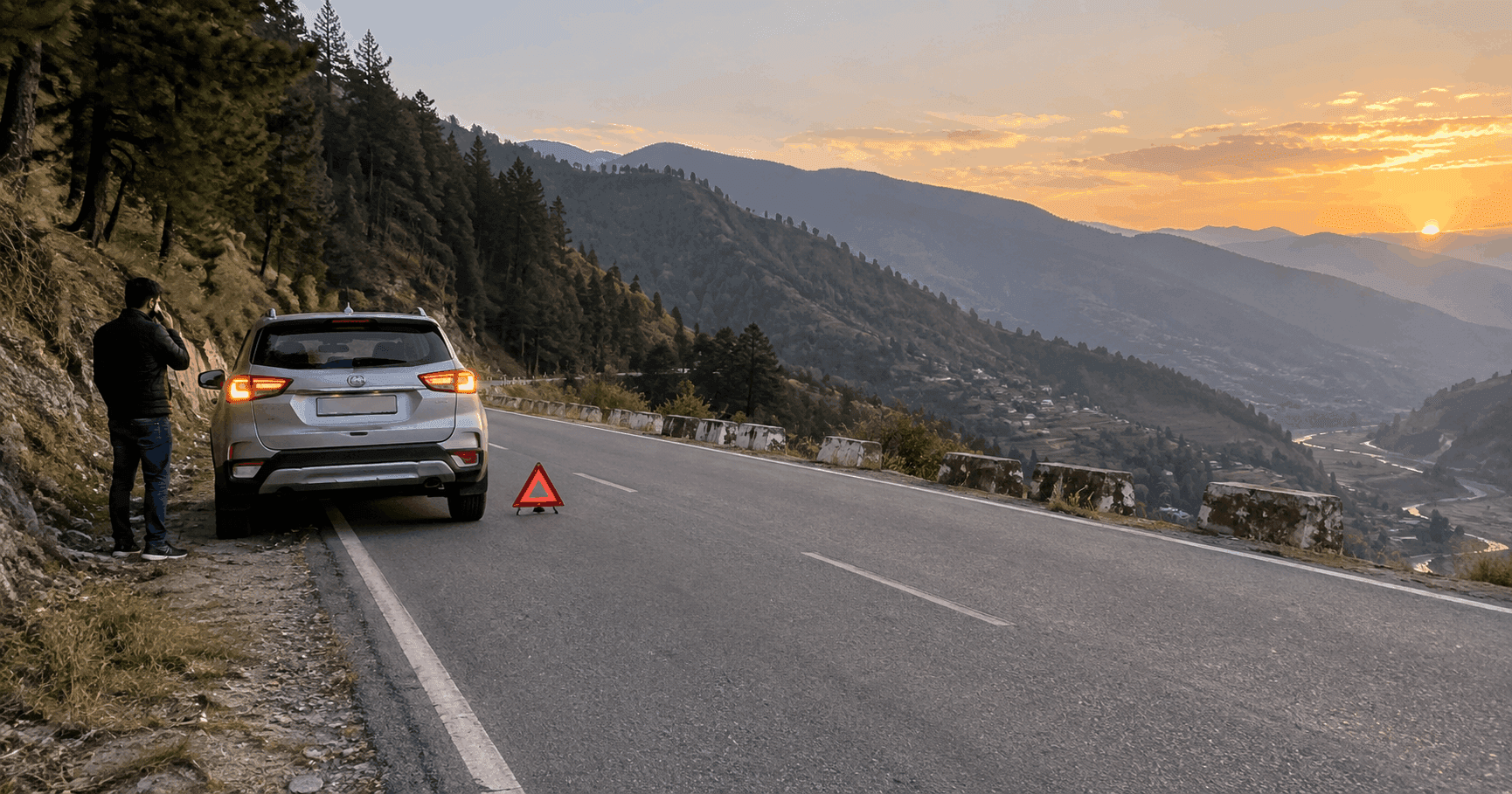
Rental car breaks down mid-trip? The exact sequence: secure the car, call the company before any mechanic, and who pays for what on Himachal road trips.
Key takeaways
- Secure the car first, then call. Hazards immediately, triangle 50 metres back on a highway, passengers out and behind the barrier.
- Ring the rental company before any local mechanic. Unauthorised repairs are the most common reason a customer ends up paying for something the company would have covered.
- Mechanical failure is usually the company's cost. Damage from negligence, off-route driving or drunk driving is yours, and punctures are almost never covered anywhere.
- Send your location as a WhatsApp pin, not a place name. "Near Aut tunnel" covers about 12 kilometres of road.
- On Spiti and Leh routes, plan for no signal at all. Agree check-in points before you leave the last town with coverage.
In this guide9 sections
If your rental car breaks down during a trip, do four things in this order: get the car off the carriageway, switch the hazards on, put the reflective triangle out behind you, and call the rental company before you call anyone else. That last one matters more than people expect. Whether a breakdown costs you money or just costs you an afternoon usually comes down to who you ring first and what you tell them.
Most guides on this stop at "stay calm and call for help." Useless at 4 pm on the Mandi bypass with a temperature needle in the red and a queue of trucks behind you. Here is the actual sequence, the money side of it, and the parts specific to Himachal roads where help is genuinely far away.
The first five minutes
Coast, do not brake hard. If the engine has cut, you still have one or two decent pushes of brake vacuum and the steering goes heavy but still works. Aim for the left shoulder, a lay-by, a dhaba forecourt, anything flat and off the running lane.
Hazards go on the instant you know something is wrong, before you have diagnosed anything. Under the Motor Vehicles (Driving) Regulations, 2017, a broken-down vehicle on a highway needs its hazard lights on immediately and reflective warning triangles placed 50 metres behind it. Fifty metres is roughly 65 normal paces. Most people put the triangle six feet from the bumper, which warns nobody.
Then get everyone out on the passenger side and behind the crash barrier or off the shoulder entirely. Sitting inside a stationary car on an Indian highway at dusk is the single riskiest thing you can do during a breakdown. Not the breakdown itself.
If anyone is hurt, or if a truck has stopped and the situation feels off, call 112. On a national highway you can also call the NHAI helpline on 1033, which is free, runs 24 hours, and can dispatch a patrol vehicle, a crane or an ambulance on tolled stretches.
Where you stop matters more in the hills
On the Chandigarh to Shimla four-lane, stopping is easy. On the older ghat sections past Narkanda or Pandoh, there is often no shoulder at all, and a stalled car on a blind curve is a serious hazard for everyone coming up behind you.
Two rules worth remembering. Never stop just past a blind bend if you can help it, roll another fifty or hundred metres to somewhere with sightline. And if you have to stop on a slope, turn the wheels into the hillside and leave it in first gear or park, handbrake up, plus a rock behind a wheel if there is one lying around. Locals do this without thinking. Visitors almost never do.
Call the rental company first, before the mechanic
This is the part that costs people money.
Every self-drive rental agreement in India has some version of a clause saying repairs must be authorised. Get a roadside mechanic to open the engine, hand him ₹4,000 in cash, and you have converted a covered mechanical failure into an unauthorised repair that the company can decline to reimburse. You have also handed the argument to whoever is on the other side of it.
SelfDriveGo's stated policy is that you call or WhatsApp immediately, and for mechanical failures not caused by driver negligence, the repair cost is covered and a replacement vehicle is arranged where possible. There are roadside assistance partners across the major Himachal routes, and every car carries a GPS tracker, which is how a company finds you when you cannot describe where you are. The full set of policies sits on the FAQ page.
One more reason to call early. A company that knows the fleet knows the car. If the Creta has a known quirk, or if a Swift went out last month with the same symptom, the person on the phone may talk you through a two minute fix rather than a two hour wait.
What to send them
Voice calls in the hills drop. WhatsApp survives on one bar. Send this, in one message:
- A live location pin, not a description. Place names are useless for dispatch.
- What the car is doing, in plain words. Not "it's making a noise." Try "high pitched whine when I accelerate, gets louder in third."
- What the dashboard shows. Photograph the cluster with the warning lights lit.
- Whether the car is drivable or completely stopped.
- Whether you are somewhere safe, and how many people are with you.
If there is smoke, a burning smell, or fluid under the car, say that first. Those three change the response from "we will send someone" to "get everyone away from the vehicle now."
Who pays for what
Broadly, the split works like this across Indian self-drive rentals.
The company's cost: engine or gearbox failure, alternator, clutch (unless you cooked it), electrical faults, anything that is the vehicle wearing out or a service item missed. This is what you are buying when you pay a day rate that includes insurance and support.
Your cost: fuel, tolls, kilometres past the daily allowance, and damage from anything the insurance excludes. On SelfDriveGo's insurance page the exclusions are drunk or drugged driving, off-road use beyond the agreed route, wilful negligence, tyre punctures, and personal belongings. Liability on a covered incident is capped at the ₹5,000 deposit for cars.
That off-route clause is the one that catches people. Take a hatchback up the Kunzum La road because the weather looked fine, break something, and the claim is gone. It is also why 4x4-only routes are a condition rather than an upsell, and why the Jimny and Thar are the only cars released for Spiti and Leh. The wider insurance-and-deposit picture is covered in our self-drive rental FAQ guide.
Punctures deserve a line of their own. No insurer in India covers a puncture, and no rental company does either. Every car should go out with a working spare and a repair kit, and it is worth checking that the spare actually holds air at handover rather than discovering it on a mountain road.
Five failures you can probably sort out yourself
A flat tyre. The most common breakdown by a distance. Change it on flat ground only, never on a slope with the jack under a moving load. Then drive to the next town and get the punctured tyre plugged, because now you have no spare, and that is the real emergency.
Overheating on a long climb. Temperature gauge climbing on the Solan or Pandoh ascent means pull over, switch the engine off, and wait. Do not open the radiator cap. Pressurised coolant at 110°C will scald you badly. Give it twenty minutes, top up with water if you have it and the level is visibly low, and drive gently to the next service point.
A dead battery. Usually the reading light left on overnight at a homestay. Jump leads in the boot turn this into a ten minute problem and any local driver will help. Without leads you are waiting for someone who has them.
Brake fade on a descent. A soft pedal and a hot smell after a long downhill is overheated brakes, not a failure. Stop somewhere safe, let them cool for a good fifteen minutes, and go back down in second gear using engine braking. Our road trip safety guide covers how to do this properly before you need it.
Stalling in a water crossing. Do not restart. Water in the intake plus a turning engine is a bent connecting rod and a five-figure repair bill. Push the car out, call it in, and let the company decide.
Anything involving smoke, a burning smell, a knocking noise from the engine, or a brake pedal that goes to the floor is not a self-fix. Stop and call.
When there is no signal
On the Tricity runs and the Shimla, Kasauli, Dharamshala and Amritsar routes, you will have coverage nearly everywhere and a breakdown is an inconvenience. Past Rohtang and into Lahaul and Spiti, it is a different kind of problem.
Between Gramphu and Kaza, through Batal and Kunzum La, there is effectively no mobile signal. BSNL is the network that works in and around Kaza and Tabo, and there is a long dead stretch between Losar and the pass. In Ladakh, prepaid SIMs issued outside the region do not work at all under long-standing security rules, so you need an active postpaid connection or a local SIM bought in Leh.
What actually helps up there:
- Agree check-in points before you leave the last town with signal. Someone should know you were due at Kaza by 6 pm.
- Download the offline map for the full route, not just the next leg.
- Carry more water and warm layers than the day seems to need. A four hour wait at 4,000 metres after sunset is a different experience from a four hour wait near Solan.
- Ask whether a satellite communicator is available. SelfDriveGo lends one for Spiti and Leh bookings.
- Stop at dhabas. Batal and Chhatru are where the recovery vehicles and the drivers who know the road actually are.
There is no clever trick for this. None. On a remote stretch the honest expectation is that help takes hours rather than minutes, and a trip plan that has no slack in it will turn a half-day mechanical delay into a missed flight out of Chandigarh three days later, which is usually the part that actually hurts. Our Spiti route guide and Manali route guide go into where the gaps are.
If the car cannot be fixed that day
Three questions to ask, in this order.
Is a replacement coming, and when? A Chandigarh-based operator can usually get another car to Shimla or Manali within a few hours. Kaza is a different conversation and may be a day.
What happens to the booking? Days lost to a mechanical failure that was not your fault should not be billed. Get that confirmed in writing on WhatsApp rather than assuming it.
Who is paying for tonight? If the car is stuck in a town you did not plan to sleep in, ask directly rather than discovering the answer at checkout. Policies differ across operators, and a clear answer at 7 pm is better than a dispute at the end of the trip.
Keep the WhatsApp thread. All of it. A dated photo of the coolant puddle under the car, the message where support told you to wait at the dhaba, the mechanic's handwritten bill, and the timestamp showing you called within ten minutes of the car stopping are collectively worth more than any amount of explaining afterwards, and they are the difference between a deposit refunded in a day and a fortnight of back and forth.
Most of this is prevented at handover
Five minutes before the car leaves your gate:
- Check the spare. Pressure and tread, not just presence.
- Confirm the jack, the wheel spanner and the triangle are in the boot.
- Confirm there are jump leads, or buy a set.
- Save the number of a person, not a helpline. SelfDriveGo gives every booking a trip-specific WhatsApp contact.
- Photograph the odometer, the fuel gauge and every existing scratch, with the person handing over the car standing there.
Picking the right car for the road does more for your odds than any of this. A Baleno on the Shimla highway is a boring, reliable weekend. The same car on a broken high-altitude track is a breakdown waiting to happen, which is the whole argument in our guide to choosing the right self-drive car.
Renting from Chandigarh, Mohali, Panchkula or Zirakpur? Every SelfDriveGo car goes out with a documented pre-delivery inspection, GPS, roadside assistance across the Himachal routes, and a WhatsApp contact who has driven the road you are on. See the full pricing or check availability for your dates.
Frequently asked questions
Who pays if a rental car breaks down during a trip?
For a genuine mechanical failure not caused by the driver, the rental company covers the repair. Damage caused by negligence, driving off the agreed route, or driving under the influence is charged to the customer, usually against the security deposit.
Can I get a rental car repaired myself and claim the money back?
Only with the company's approval first. Ring them, describe the fault, and get a yes on WhatsApp before any mechanic opens the bonnet. Unauthorised repairs are frequently declined, and you will be arguing about it later from a weak position.
What if the rental car breaks down somewhere with no mobile signal?
Stay with the vehicle if it is safe, flag down a passing truck or bus driver, and ask them to pass a message at the next town with coverage. This is why agreed check-in points matter on Spiti and Leh routes, and why a satellite communicator is worth asking about.
Does the security deposit get taken for a breakdown?
Not for a mechanical failure. The deposit covers damage and excluded incidents. With SelfDriveGo the ₹5,000 car deposit is refunded within 24 hours of return when there is no damage beyond normal wear.
Do I get a refund for the days lost to a breakdown?
Ask, and get the answer in writing. Days lost to a fault that was not your doing are normally adjusted or refunded, but the specifics vary by operator and by how long the car was off the road.
Is a puncture covered by rental insurance?
No. Tyre punctures are excluded from comprehensive motor insurance in India as standard, which is why cars go out with a spare and a repair kit. Get the punctured tyre plugged at the next town so you are not running without a spare.
Ready to drive this route?
WhatsApp us and we will suggest the right car, plus send you a route PDF.