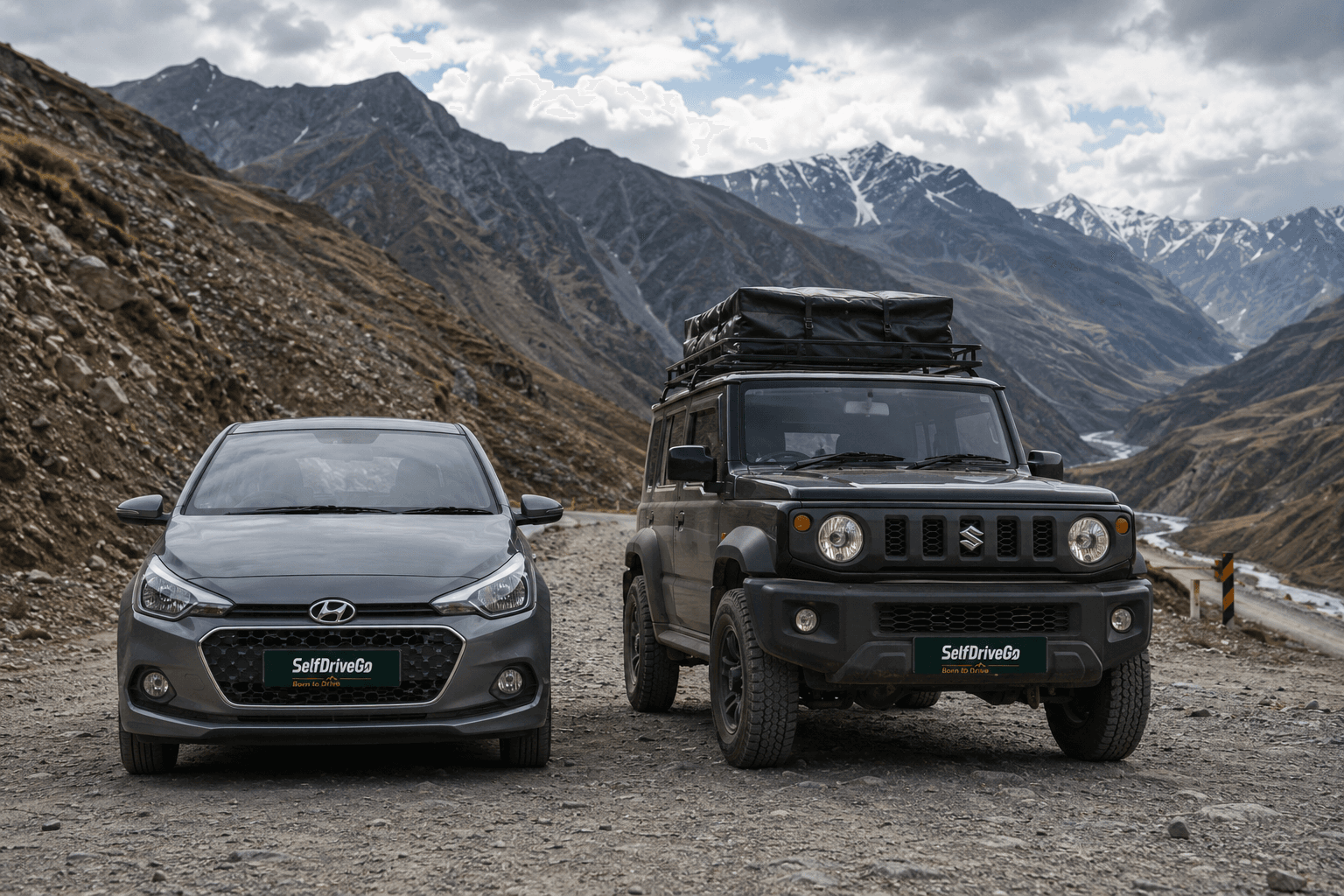
A no-nonsense guide to picking the right self-drive car by terrain, group size, transmission, and budget, before you book your next road trip.
Key takeaways
- Terrain decides more than any other factor, a soft-roader can get stuck exactly where a proper 4x4 doesn't, e.g. past Gramphu toward Spiti
- Match seats to real headcount, not the spec sheet, 5 seats gets tight fast with 5 adults and a week of luggage
- Automatic vs manual only becomes non-negotiable at altitude, comfort choice on paved roads, requirement once you're on loose gravel or switchbacks
- The daily rate isn't the real cost, fuel, km limits, and extra-km charges move the total more than the sticker price
- For Himachal high-altitude routes, the car matters more than the company, ties back to your "we've driven every route" positioning
In this guide8 sections
The right self-drive car for your journey comes down to three questions, asked in that order: what kind of road are you actually driving on, how many people and how much luggage are coming with you, and what does the trip cost once fuel and kilometre limits are added to the daily rate. Answer those honestly and the choice between a hatchback, a sedan-class hatch, an SUV, and a 4x4 mostly makes itself.
Most car rental blogs list every possible filter, mileage, seating, budget, safety features, in one long undifferentiated pile, as if they all carry equal weight. They don't. Terrain overrules almost everything else, and a lot of first-time renters find that out the expensive way, halfway up a pass their car was never built to climb. This guide ranks the factors the way they actually matter and points you to the specific vehicles worth considering at each stage.
Key takeaways
- Terrain decides more than any other factor. A soft-roader SUV can get stuck on the exact stretch a proper 4x4 handles without drama, commonly past Gramphu on the way to Spiti.
- Match seats to your real headcount, not the number on the spec sheet. A car listed for 5 seats gets tight fast with 5 adults and four days of luggage.
- Automatic is a comfort upgrade on highways and paved hill roads. Manual with low-ratio gearing stops being optional once you're past a certain altitude or surface.
- The daily rental rate is not the real cost of the trip. Fuel, kilometre limits, and extra-km charges move the total more than the sticker price does.
- For high-altitude Himachal routes, Spiti, Leh, and Rohtang especially, which car you're driving matters more than which company you rented it from.
In this guide
- Start with the road, not the car
- How many people, how much bag space
- Manual or automatic, when it actually matters
- Choosing between a hatchback, SUV, and 4x4
- The quick picker: car by route
- Where people get this wrong
- What the daily rate doesn't tell you
- The bottom line
- Frequently asked questions
Start with the road, not the car
Before you look at a single car, decide what kind of driving you're actually doing, because the categories aren't as fuzzy as they sound.
City and highway driving covers commutes, airport runs, and flat inter-city stretches. Anything with decent tyres and a service history handles this fine. Paved hill stations, Kasauli, Shimla, Dharamshala, are the next step up. Winding roads, but tarmac the whole way, so a well-maintained hatchback or compact SUV is genuinely enough. High-altitude terrain is a different animal: Manali's approach roads, Rohtang, the Spiti circuit, and the Leh-Manali highway, where broken tarmac, river crossings, and altitude change what "handles fine" even means.
That last category is where car choice stops being a preference and starts being a constraint. We've personally driven the Kunzum and Rohtang stretches before ever adding a car to our own fleet, and the difference between a 4x4 with low-ratio gearing and a soft-roader SUV isn't comfort, it's whether you get through at all. If your route touches Spiti or Leh, read this before you fall in love with a car that looks the part but isn't built for it.
How many people, how much bag space
Seating capacity on a spec sheet assumes small adults sitting still for twenty minutes. A multi-day trip is a different test. Four people and their bags for a week look nothing like four people for a school run.
A hatchback like the Swift or Baleno comfortably does two adults with real luggage, or four adults travelling light. Push it to five adults with duffel bags for a week and the boot runs out before the trip does. A compact SUV like the Creta buys you more shoulder room and a genuinely larger boot without stepping up to a full-size vehicle, which is why it shows up so often as the pick for family trips to Shimla or Dharamshala. For six or seven people, or serious luggage, the Scorpio N and Fortuner exist for a reason, don't try to force that group into a car built for four.
Manual or automatic, when it actually matters
On a flat highway or a paved hill road, automatic versus manual is a comfort call, nothing more. Traffic-heavy stretches favour automatic simply because you're not working the clutch every ninety seconds.
That changes above a certain altitude. Low-ratio gearing, the kind that lets a manual 4x4 crawl through loose gravel or a steep switchback without stalling, isn't something automatic soft-roaders replicate. It's part of why the Jimny in our fleet is manual only, and why the Thar comes in both, manual for the routes where it earns its keep, automatic for the ones where it doesn't need to. If you're not sure which category your trip falls into, that's a fair question to ask before you book, not after you're stuck in second gear at 12,000 feet.
Choosing between a hatchback, SUV, and 4x4
Body type | Genuinely good for | Where it falls short |
|---|---|---|
Hatchback (Swift, Baleno) | City driving, paved hill stations, 2-4 people | Multi-day luggage for 5, rough terrain |
Compact SUV (Creta) | Family trips on paved hill roads, extra boot space | High-altitude passes, river crossings |
4x4 SUV (Jimny, Thar) | Spiti, Leh, Rohtang, anything past the tarmac | Everyday city parking, fuel economy |
Full-size SUV (Scorpio N, Fortuner) | 7-seat groups, long highway days, comfort at altitude | Tight hill-town streets, budget trips |
Pickup (Hilux) | Heavy luggage, expedition-style trips | Anyone who needs to parallel park often |
None of these is a universal answer. The industry habit of upselling an SUV "just in case" for a route that never needed one is, frankly, a way to sell a bigger booking, not a better trip. If your itinerary is Kasauli and back, a Baleno will do everything the SUV would have, for less money and less hassle in a narrow hill-town lane.
The quick picker: car by route
If you already know your destination, this shortcuts most of the thinking above.
Route | Recommended car | Why |
|---|---|---|
Short, paved, easy grade | ||
Paved throughout, Creta if travelling as a family | ||
Any well-serviced hatchback or SUV | Good roads year-round | |
Jimny if you're continuing toward Solang or Rohtang | ||
Mandatory past Gramphu, no real substitute | ||
4x4 required for Baralacha La and beyond |
Heading to Solang Valley or another trailhead once you arrive? A mountain bike strapped to the roof rack covers the last stretch a car can't, and pairing one with your rental usually comes with a discount worth asking about.
Where people get this wrong
Renting the bigger car "to be safe." An SUV for a flat highway weekend mostly buys you a harder parking search and a bigger fuel bill, not extra safety. Match the car to the road, not to a worst-case scenario that doesn't apply to your route.
Assuming any SUV is a 4x4. A lot of soft-roader SUVs are front-wheel drive with SUV styling. They're excellent on paved hill roads and genuinely wrong for Spiti or Leh. Ask specifically whether the vehicle has real 4x4 capability with low-ratio gearing, not just "SUV" on the listing.
Ignoring the kilometre limit for a long one-way trip. A car with a 300 km/day cap is fine for a loop but can quietly run up extra charges on a longer push. Check the limit against your actual planned distance before booking, our pricing page lists this per vehicle.
Choosing on price alone for a mountain route. The cheapest car that can't finish the trip costs more than the right car that does, once you count a tow, a missed booking, or a ruined itinerary. We've written more on this in our safety tips for a first self-drive road trip.
What the daily rate doesn't tell you
Published day rates on our fleet currently run from roughly ₹1,199 for a Swift up to ₹7,999 for a Fortuner, with the Jimny and Thar sitting in the ₹4,000-ish range for 4x4 capability. Treat these as a starting point, not the full number, prices shift with season and demand, so confirm the current rate before you book.
What actually moves the total: fuel isn't included on most rentals, so budget it separately, and per-day kilometre caps mean a Spiti or Leh trip needs a car with a limit that matches the distance, not just the terrain. A cheaper car with a tighter km cap can end up costing more than a pricier one with room to spare, do the arithmetic against your actual route before deciding on price alone.
The bottom line
Pick the road first: city and highway, paved hill station, or high-altitude pass. Then match seats and boot space to who's actually coming, not the number on the listing. Automatic is comfort, manual with low-ratio is a requirement once the tarmac ends. Everything else, colour, brand, features, is preference, not a decision that changes whether your trip works.
If you haven't sorted documents, deposits, or interstate permits yet, our ultimate guide to renting a self-drive car in India covers that ground. And if you're still weighing a self-drive rental against just booking a cab, we've compared the two honestly here.
Ready to drive this route? WhatsApp us your destination and dates, we'll tell you straight whether the car you're eyeing actually suits it, or point you to our full fleet to compare on your own.
Frequently asked questions
Is an SUV always the safer choice for a road trip?
Not automatically. Safety on a paved highway or hill road comes down to the vehicle's condition and the driver, not body style. An SUV earns its place on rough or high-altitude terrain, where ground clearance and 4x4 capability genuinely matter.
Do I need a 4x4 for Shimla or Kasauli?
No. Both routes are paved the whole way, and a well-serviced hatchback or compact SUV covers them without issue. Save the 4x4 for Spiti, Leh, or Rohtang.
Should I pick automatic or manual for hill driving?
Automatic is fine and more comfortable for paved hill roads like Shimla or Dharamshala. Once you're on loose gravel, switchbacks, or high-altitude passes, manual with low-ratio gearing does something automatic soft-roaders can't replicate.
Is the Jimny really mandatory for Spiti and Leh?
For the stretches past Gramphu and over Baralacha La, yes, in practical terms. These sections combine altitude, loose surfaces, and river crossings that a soft-roader SUV isn't built to handle reliably.
What's the right car for a family of five with luggage?
A compact SUV like the Creta usually strikes the right balance of seating and boot space for paved routes. For a genuinely large family or heavy luggage, a 7-seat option like the Scorpio N or Fortuner fits better than forcing everyone into a 5-seater.
Does a lower daily rate mean a cheaper trip overall?
Not necessarily. Fuel, kilometre limits, and extra-km charges can turn a cheap-looking rate into a more expensive trip than a pricier car with a limit that actually matches your route. Check the full cost, not just the headline number.
Ready to drive this route?
WhatsApp us and we will suggest the right car, plus send you a route PDF.